Klong
- Created Wednesday 15 July 2026
Klong in a browser
I built Klong for the Web, a browser notebook for Nils M Holm's small array language. The interface works like a small Jupyter notebook: cells share interpreter state and can run individually or together. Notebooks persist locally, .kg files can be imported and exported, and the installed web app works offline.
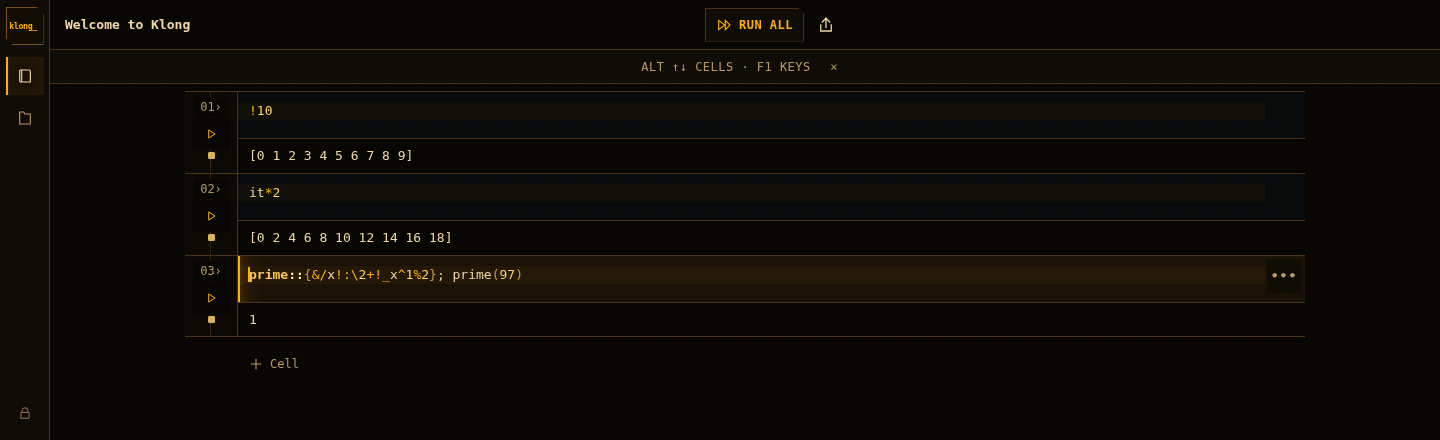
The Klong interpreter checks that 97 is prime and returns 1.
The example comes from the Klong website:
prime::{&/x!:\2+!_x^1%2}
prime(97)
The site runs Holm's C interpreter, not a JavaScript reimplementation. I compiled it to WebAssembly; a thin bridge feeds source files to it and captures its normal output. Execution happens in a dedicated browser worker, so stopping a runaway program does not freeze the page. There is no execution server or account.
It is a practical companion to Holm's book, An Introduction to Array Programming in Klong: read a section, try the examples, change them, and keep the useful results in a notebook.
J on an airplane
Many years ago I learned J on an airplane using an interpreter I found for the iPad. I relish long flights for this kind of thing. A few uninterrupted hours are enough to try a new language or paradigm.
J impressed me with its array-oriented thinking and concision. A small expression could describe a whole computation without loops, indexes, or temporary variables.
A few weeks later I understood why people sometimes call array languages "write only." The skill was remarkably perishable. What bothered me most was contextual operator overloading: a symbol could mean different things in different surroundings. Those distinctions were among the first things I forgot, and I never kept up with J.
Finding Klong
Later I found Klong, a small array language inspired by K. It had the dense expressions and whole-array operations I remembered liking.
Klong also addressed my specific objection. Its syntax is unambiguous: fold, convergence, iteration, and looping have distinct spellings. Klong came with a clear reference manual, Holm's book, and a small, free C interpreter I could read and hack on.
Then my family grew, and I had fewer long stretches for learning languages. I kept Klong in mind but rarely sat down with it. Putting the interpreter in a browser gives me a way to use it from my phone or computer without first setting up a development environment.